
Designing Scalable WordPress Plugins with SOLID Principles and Clean Architecture
Learn how to build scalable WordPress plugins using SOLID principles, Clean Architecture, and PHP OOP, with practical examples of business logic separation, testing, and maintainability.
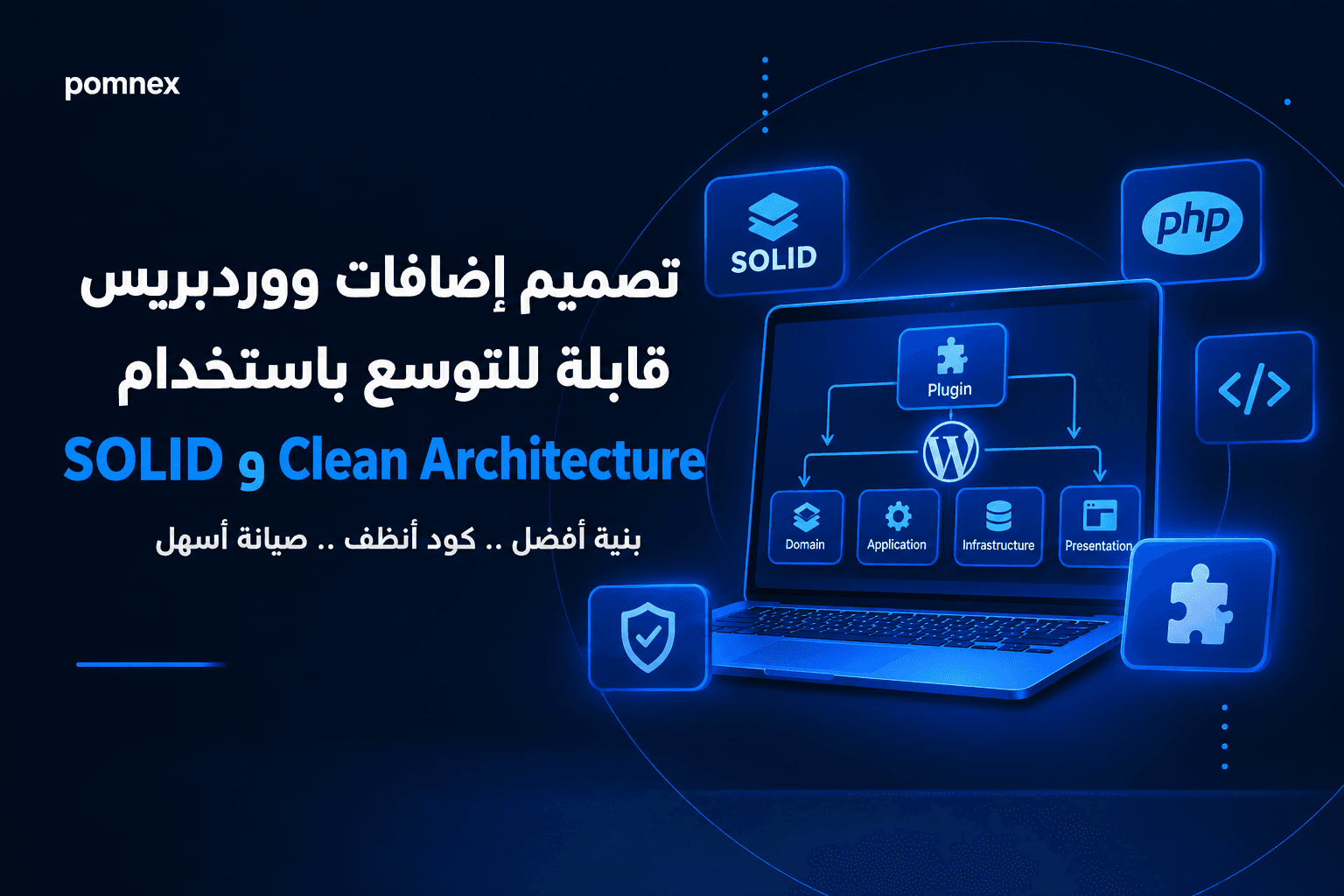
Designing Scalable WordPress Plugins with SOLID Principles and Clean Architecture
A WordPress plugin rarely starts out complicated. A few PHP files, a handful of hooks, and a settings page are often enough to solve the initial problem. The difficulty appears later, when the plugin needs to support external APIs, scheduled jobs, custom permissions, multiple workflows, and compatibility with other plugins.
At that point, the question is no longer how to make the code work. It is how to keep it understandable, testable, and safe to change without introducing regressions every time a new feature is added.
At Pomnex, we approach custom WordPress plugin development with maintainability and clear architecture as part of the initial design, rather than cleanup work to postpone until later.
This article looks at how SOLID principles and Clean Architecture can help you build better WordPress plugins without turning every project into an unnecessarily complex framework.
If you are evaluating whether to build a custom solution or use an existing plugin, our article on custom vs. off-the-shelf WordPress plugins provides useful context before you commit to an architectural direction.
Why WordPress Plugin Architecture Becomes a Problem
Imagine building a WooCommerce extension that applies discounts based on a customer's order total and item quantity.
The first version is straightforward: check a few conditions and calculate the discount. Then the requirements grow. Administrators need to configure the rules, the system must log decisions, an external service must be integrated, and the same business logic needs to be available through a REST API.
If everything lives in one large class or a collection of tightly coupled functions, even a small change can become difficult to make confidently.
The problem is not the number of lines. It is the number of responsibilities that change together.
The solution is not to create a class for every function. It is to identify meaningful boundaries, isolate the rules that matter to the business, and keep infrastructure details from spreading throughout the application.
1. Applying SOLID Principles to WordPress Plugins
SOLID is not a requirement to introduce five layers into every plugin. These principles help reduce coupling and make components easier to understand, replace, and test.
Single Responsibility Principle
A class should have one clear reason to change.
For example, a class that calculates discounts should not also render an admin page, save settings, send notifications, and write audit logs.
A more maintainable design might separate these responsibilities:
A domain class defines discount eligibility.
An application service performs the discount calculation.
A WordPress adapter handles persistent settings.
An admin component renders the interface and processes user actions.
If the administration interface changes, the discount rules remain untouched. If the business changes its discount policy, the UI does not need to be rewritten.
The goal is not to minimize the size of every class. It is to keep unrelated changes from forcing modifications to the same component.
Open/Closed Principle
Software should be open to extension without requiring widespread modifications to existing code.
WordPress already provides a useful mechanism for this: actions and filters.
A plugin can expose a documented filter that allows another developer to modify a calculated result or adjust a configurable rule, rather than requiring edits to the plugin's own files.
However, not every internal function needs to become an extension point. Public hooks should represent intentional customization opportunities, with predictable inputs, outputs, and behavior.
A plugin that exposes dozens of poorly documented filters is not necessarily more extensible than one with a small, deliberate API.
For details on how WordPress actions and filters work, see the official WordPress Hooks Handbook.
Liskov Substitution Principle
If a component depends on a contract, alternative implementations of that contract should behave in ways that preserve the expectations of the calling code.
Consider a plugin that retrieves customer data from different sources. One implementation might use WordPress user metadata, while another retrieves information from an external API.
If both implementations honor the same contract, the application can switch between them without rewriting its business rules.
That does not mean every variation deserves an inheritance hierarchy. In PHP, composition and dependency injection are often simpler than long chains of subclasses, especially when components have different responsibilities.
Interface Segregation Principle
Components should not depend on large interfaces containing operations they never use.
For example, a component that only reads plugin settings should not need an interface that also includes deleting records, sending emails, and managing user accounts.
Smaller interfaces make dependencies more explicit. They also simplify tests because a test double needs to implement only the behavior the component actually consumes.
Dependency Inversion Principle
Core business rules should not depend directly on low-level infrastructure details.
In a WordPress plugin, this can mean keeping calls to functions such as get_option() or wp_remote_get() out of the classes that implement business policies.
Instead, a WordPress-specific component can retrieve the required data and pass it to an application service. Where appropriate, the application can depend on an interface that has a WordPress implementation in production and a lightweight test implementation in the test suite.
The point is not to eliminate the WordPress API. It is to prevent WordPress-specific details from becoming dependencies everywhere in the codebase.
2. What Clean Architecture Means for a WordPress Plugin
Clean Architecture is built around a simple idea: the most important business rules should not depend directly on the framework, database, or user interface.
For a medium-sized or large WordPress plugin, the responsibilities can be organized into four logical areas.
Domain
Contains the fundamental business rules, such as whether a customer qualifies for a discount or whether an order can transition to a particular state.
Application
Coordinates use cases: calculating a discount, processing an import, or initiating a synchronization.
Infrastructure
Handles technical details such as database access, external API clients, persistence, and logging.
Presentation and WordPress integration
Contains admin screens, REST API controllers, hook registrations, request validation, permission checks, and the code that connects incoming WordPress events to application services.
These do not have to be four physically isolated layers in every project. A small plugin may need only a few well-organized classes. A larger extension with multiple workflows may benefit from a clearer separation.
Clean Architecture is useful when it reduces meaningful dependencies. It becomes counterproductive when the abstractions add more work than they remove.
3. A Practical Example: Separating Business Logic from WordPress
Suppose a discount policy grants 10% off when an order subtotal reaches at least 100 currency units and contains three or more items.
The following example uses PHP 8.0 or later. It represents monetary amounts as integer minor units; 10000 means 100.00 for a currency with two decimal places.
First, isolate the eligibility rule in a domain class:
<?php

namespace Pomnex\Promo\Domain;

final class DiscountPolicy
{
    public function isEligible(
        int $subtotalMinorUnits,
        int $quantity
    ): bool {
        return $subtotalMinorUnits >= 10000
            && $quantity >= 3;
    }
}
Notice what this class does not do. It does not call WordPress functions, query the database, or know whether the request originated from WooCommerce or a REST endpoint.
It answers one question: does the order meet the eligibility criteria?
Next, implement the application service that calculates the discount:
<?php

namespace Pomnex\Promo\Application;

use Pomnex\Promo\Domain\DiscountPolicy;

final class CalculateDiscount
{
    public function __construct(
        private DiscountPolicy $policy
    ) {
    }

    public function execute(
        int $subtotalMinorUnits,
        int $quantity
    ): int {
        if (
            !$this->policy->isEligible(
                $subtotalMinorUnits,
                $quantity
            )
        ) {
            return 0;
        }

        return (int) round(
            $subtotalMinorUnits * 0.10,
            0,
            PHP_ROUND_HALF_UP
        );
    }
}
The monetary values here are illustrative. A production financial integration must follow the currency precision and rounding conventions of the surrounding system, including WooCommerce where applicable.
What have we gained?
We can test discount eligibility and calculation with PHPUnit without bootstrapping WordPress. The same service can later be called from an admin workflow, a REST controller, or a WooCommerce integration without copying the business rules into each entry point.
That is the practical value of architectural separation: changing where the logic is used does not require rewriting the logic itself.
4. Organizing the Plugin with Namespaces and Composer
As a plugin grows, manually requiring class files becomes increasingly difficult to maintain. Namespaces and Composer's autoloader provide a cleaner way to organize the code.
A starting structure might look like this:
pomnex-promo/
├── pomnex-promo.php
├── composer.json
├── src/
│   ├── Plugin.php
│   ├── Domain/
│   │   └── DiscountPolicy.php
│   ├── Application/
│   │   └── CalculateDiscount.php
│   ├── Infrastructure/
│   │   └── WordPress/
│   └── Presentation/
│       └── Admin/
└── tests/
Define a PSR-4 mapping in composer.json:
{
  "autoload": {
    "psr-4": {
      "Pomnex\\Promo\\": "src/"
    }
  }
}
Generate the autoloader with:
composer dump-autoloadThe namespace-to-directory mapping must follow PSR-4, including case-sensitive namespace and filename matching. The complete rules are available in the official PHP-FIG PSR-4 specification.
The main plugin file then loads Composer and boots the application:
<?php
/**
 * Plugin Name: Pomnex Promo
 * Description: Example of a structured WordPress plugin.
 * Version: 1.0.0
 */

if (!defined('ABSPATH')) {
    exit;
}

require_once __DIR__ . '/vendor/autoload.php';

add_action(
    'plugins_loaded',
    static function (): void {
        (new \Pomnex\Promo\Plugin())->boot();
    }
);
This is the entry point, not the complete plugin. The Plugin class must implement boot() and register the appropriate WordPress hooks and adapters.
When distributing a plugin to sites where Composer is not available, include the generated autoloader and required dependencies in the release package. Also consider dependency conflicts with libraries loaded by other plugins.
The vendor directory is a build and distribution detail, not a reason to expose Composer or the application container throughout every class.
5. Security Is an Architectural Concern
Clean architecture does not automatically make a plugin secure.
In WordPress, input handling, authorization, business logic, and output rendering should have clear responsibilities.
When building an admin page or REST endpoint:
Check user permissions with
current_user_can()or the appropriate authorization mechanism for the request.Use nonces in the contexts where they provide CSRF protection. A nonce is not a substitute for authorization.
Validate incoming data against the expected type, range, and permitted values.
Escape output for its context, using functions such as
esc_html(),esc_attr(), andesc_url().Use prepared SQL queries when writing custom SQL, rather than concatenating user-controlled values into query strings.
The WordPress Security Handbook explains these protections and how they fit into WordPress development.
A useful architectural boundary is to let the integration layer verify that the request is valid and authorized, then invoke the appropriate application service. The service should still enforce its own business rules instead of trusting that every caller has applied them correctly.
For plugins that support important business workflows, architecture must also account for maintenance, compatibility, and the effects of future updates. These concerns are closely related to ongoing WordPress maintenance and operations.
6. Testing: Can You Change the Behavior Without Breaking the System?
One sign of a good architecture is that you can test the core rules without creating a complete WordPress installation for every test.
Start with unit tests for domain rules and application services that do not depend on WordPress APIs. Add integration tests when you need to verify database behavior, hook registration, or interactions with the actual WordPress environment.
For the discount example, useful cases include:
A subtotal below the threshold.
A quantity that does not meet the requirement.
An eligible order.
Invalid or missing input.
A changed discount policy that should not affect unrelated use cases.
Use PHPUnit for unit testing and the WordPress test suite for integration behavior that depends on the platform. The official PHPUnit documentation covers supported versions and testing features.
There is little value in chasing a coverage percentage while leaving critical business rules untested. Prioritize behavior that could cause a financial error, a security vulnerability, or a regression that goes unnoticed in production.
7. Common Mistakes When Applying SOLID and Clean Architecture
The biggest mistake is treating these principles as a checklist instead of tools for solving real problems.
Creating a class for every function. This increases the number of files and navigation steps without necessarily separating meaningful responsibilities.
Building a large dependency injection container for a small plugin. If a few objects can be constructed clearly in the application entry point, that may be simpler and easier to maintain.
Abstracting the entire WordPress API. You do not need a replacement interface for every WordPress function. Isolate the dependencies that genuinely complicate testing or create unwanted coupling.
Using inheritance everywhere. Composition and dependency injection are often more flexible than deep inheritance hierarchies.
Ignoring the plugin lifecycle. Activation, deactivation, uninstall, data migration, and compatibility are separate concerns. Temporary cleanup during deactivation is not the same as permanently deleting user data during uninstall.
The right architecture is not the one with the most abstractions. It is the one that lets the team make changes safely without introducing unnecessary complexity.
Final Thoughts: Build for the Requirements You Actually Have
Not every WordPress plugin needs a complete Clean Architecture implementation. But plugins with growing business logic, complex permissions, and external integrations benefit from clear boundaries between responsibilities.
Separate business rules from WordPress-specific code when doing so provides a real advantage. Use Namespaces and Composer to organize larger codebases, apply SOLID principles to reduce unnecessary coupling, and test important behavior before release.
Good architecture does not make a project look more sophisticated. It makes the next change less expensive, the tests more reliable, and the code easier for another developer to understand and maintain.
When off-the-shelf plugins do not cover your requirements, explore Pomnex custom WordPress plugin development to see how specific business requirements can be translated into maintainable, well-structured software.
Related articles
wordpress-maintenanceWordPress Development
WordPress vs Custom Development: How to Choose the Right Technology
WordPress or a custom framework? Compare the advantages, limitations, costs, and scalability of WordPress, Laravel, and Next.js to choose the right approach for your project.
WordPress Development
Custom vs Off-the-Shelf WordPress Plugin: When Do You Actually Need a Custom Plugin?
When do you need a custom WordPress plugin instead of an off-the-shelf one? Four measurable criteria: plugin stacking, 3-year subscription cost, abandoned-plugin vulnerabilities, and private API integrations, plus when off-the-shelf is the better choice.