
In-House WordPress Developer vs. Outsourced Maintenance: The Real Cost, in Numbers
Hire a WordPress developer or outsource maintenance? We compare published salaries in the UAE, Saudi Arabia, Germany and the UK with a $149/month plan, and explain when an in-house team wins
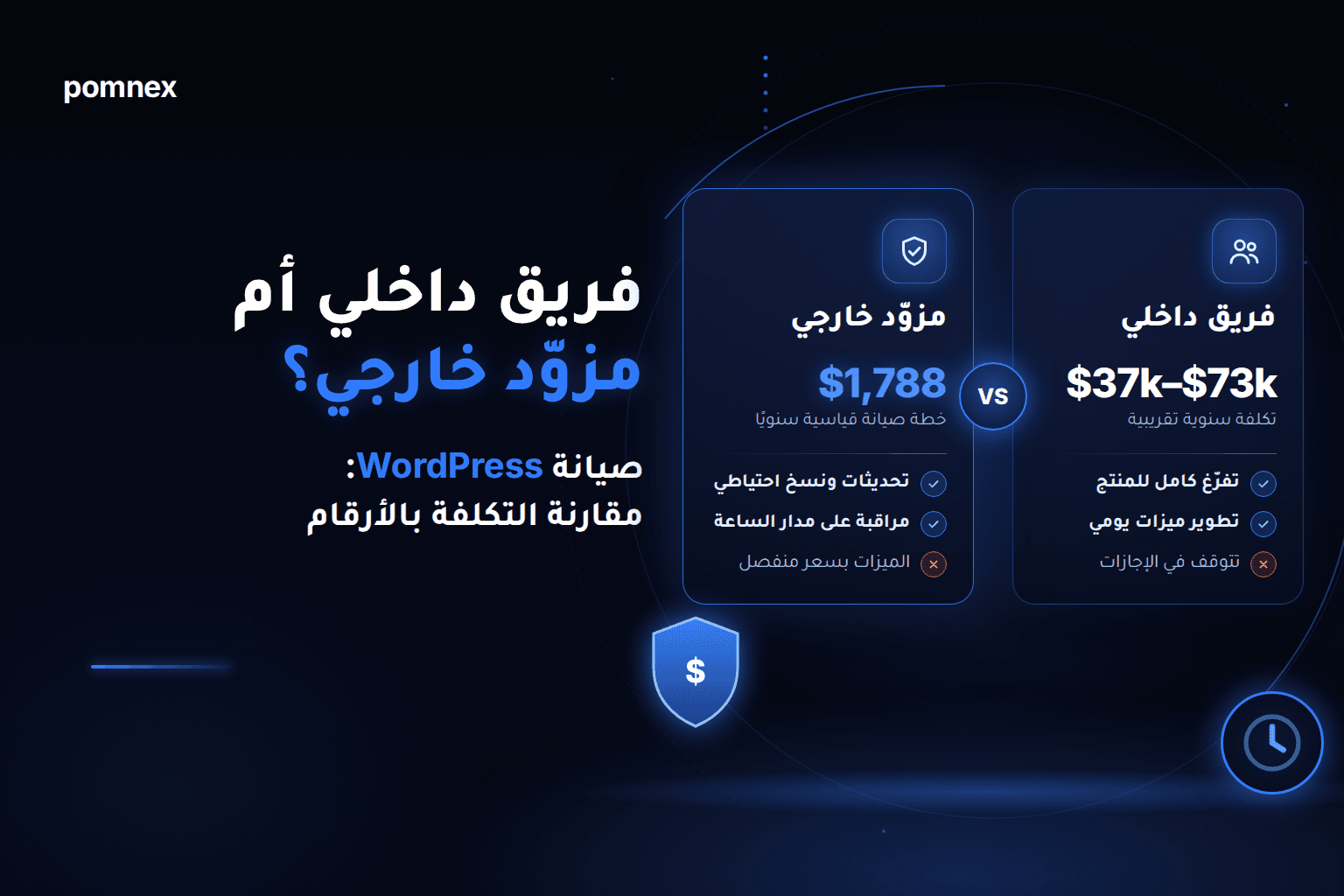
Once a business depends on its WordPress site, one question always comes up: do we hire a developer to own the site, or hand operations and maintenance to an outside provider? Most articles that answer it are written by someone selling one side, so the numbers stay vague and the conclusion is decided before the first paragraph.
This one works differently. We put published salary figures for WordPress developers in the UAE, Saudi Arabia, Germany, and the UK side by side, with the source named next to every number, and compare them with the cost of a publicly priced maintenance plan. Then we say plainly when an in-house team is the better call, even though that isn't the answer that benefits us as a provider.
New to the topic? Start with What Is WordPress Website Maintenance? A Complete Guide for Businesses.
Before the numbers: what are we actually comparing?
A fair comparison starts by being clear about what each option delivers. An in-house developer and a maintenance provider are not the same thing:
An in-house developer is a full-time person dedicated to your company: maintenance, new features, design changes, integrations with your systems, and often tasks that have nothing to do with the site.
An outsourced maintenance plan has a defined scope: core, plugin, and theme updates; backups; security, uptime, and performance monitoring; and checking the site after every update and fixing what broke. New features are development work, priced separately.
So the real question isn't "which is cheaper?" It's how many hours of work does your site genuinely need each month, and of what kind? If the need is maintenance and operations, comparing against a full salary is useful. If you have a continuous development roadmap, the math changes, and we'll get to that.
What does an in-house WordPress developer actually cost?
We collected published averages from public sources and picked the most complete source for each country. Dates matter, because these pages are refreshed regularly.
UAE
Average annual salary: AED 184,790 (~$50,300), per ERI – UAE, updated 26 September 2026.
Employer add-ons: end-of-service gratuity of 21 days' basic pay per year for the first 5 years (Gulf News).
Approximate cost to the company: up to ~AED 195,570 (~$53,250).
Saudi Arabia
Average annual salary: SAR 139,182 (~$37,100), and SAR 156,214 in Riyadh, per ERI – Saudi Arabia, updated 26 September 2026.
Employer add-ons: social insurance and end-of-service benefits (not calculated here).
Approximate cost to the company: $37,100 as a floor.
Germany
Average annual salary: €52,839, per ERI – Germany.
Employer add-ons: roughly 21% employer share of social insurance (GTAI).
Approximate cost to the company: ~€63,900 (~$72,800).
United Kingdom
Average annual salary: £36,552, per Glassdoor UK (71 salaries, May 2026).
Employer add-ons: employer National Insurance at 15% on earnings above £5,000 (Deloitte).
Approximate cost to the company: ~£41,300 (~$54,500) before pension contributions.
How to read these numbers fairly:
UAE gratuity is calculated on basic salary only, excluding allowances. We applied it to the full salary, so the figure above is a ceiling, not an average.
Glassdoor Germany shows a higher figure, €64,987 (Glassdoor), but it's based on only 5 salaries, so we used the more conservative ERI figure. With Glassdoor's number, the loaded cost rises to about €78,600.
Why no Glassdoor for the Gulf? Its Dubai and Riyadh pages rest on tiny samples (13 salaries in Dubai, one in Riyadh) and the figures are inconsistent. Transparency means saying so, rather than picking whichever number flatters the comparison.
The low end of the market: job-posting data on Indeed UAE gives a much lower average of AED 3,977 per month in Dubai (35 postings, as of September 2026), which mostly reflects junior roles. We use it below as the worst case for our argument.
Exchange rates: the dirham and riyal are pegged to the dollar (3.6725 and 3.75). Euro and pound are converted at roughly the 25 September 2026 rate ($1.139 and $1.32).
The costs that don't show up on the payslip
Salary isn't the whole picture. Some costs are hard to put an exact number on, but they're real:
Hiring itself: the average cost per hire for non-executive roles in the US is $5,475, per SHRM's 2025 Benchmarking Report (report summary). It's a US figure, but it shows the size of the line item.
Coverage gaps: annual and sick leave mean the site has no owner for weeks every year, unless you hire a second person.
Tooling: monitoring, backup, vulnerability scanning, and a staging environment cost money either way; with an outsourced plan they're included in the price.
Single-person risk: when the developer leaves, knowledge of the site and its history leaves too, unless everything is documented.
What does an outsourced maintenance plan cost?
Take a publicly priced example that doesn't require a sales call: Pomnex WordPress Care & Maintenance at $149 per month per website, or $1,788 per year, with a one-time $99 setup fee (waived during launch) and a 30-day money-back guarantee. Large sites, complex stores, and multisite networks start at $349 per month ($4,188 per year).
To keep the comparison honest, here's what the plan does not cover: adding new features or changing the design. That's custom WordPress plugin development, quoted separately.
The head-to-head comparison
Comparing the annual cost of an in-house developer with the standard plan ($1,788) and the custom plan ($4,188):
UAE: an in-house developer costs about $53,250 a year. The standard plan is about 30× cheaper; the custom plan about 13× cheaper.
Saudi Arabia: an in-house developer costs about $37,100 a year. The standard plan is about 21× cheaper; the custom plan about 9× cheaper.
Germany: an in-house developer costs about $72,800 a year. The standard plan is about 41× cheaper; the custom plan about 17× cheaper.
United Kingdom: an in-house developer costs about $54,500 a year. The standard plan is about 30× cheaper; the custom plan about 13× cheaper.
Even in the worst case for our argument, the Indeed average for Dubai (about AED 47,700 a year, roughly $13,000), the standard plan is still about 7× cheaper.
A fairer way to read it: how many hours does the same money buy?
Comparing against a full salary assumes you'd hire someone purely for maintenance, which rarely happens. The fairer question: how many hours of an in-house developer's time does $149 a month buy? Using published hourly rates (with employer add-ons where we calculated them):
UAE: AED 88.84/hour (ERI) → about 6 hours a month.
Saudi Arabia: SAR 66.91/hour (ERI) → about 8 hours a month.
Germany: ~€25/hour (ERI) + 21% add-ons → about 4 hours a month.
UK: £41,300 over 1,950 working hours a year → about 5 hours a month.
That's the real takeaway: if maintaining and monitoring your site takes more than 4–8 hours a month of an in-house developer's time (updates, post-update testing, backup checks, following up on alerts, fixing breakage), an outsourced plan is cheaper even if you already employ a developer. If your site is small, stable, and needs less than that, your existing developer may cover it for less.
When is an in-house team the better choice?
This section is the reason the article exists. There are real situations where hiring in-house is a better decision than any outside provider:
The site is the product. If your WordPress platform is your main source of revenue and needs new features every week, a developer who knows the product and works with your team daily can't be replaced by a maintenance contract.
There's a full-time job's worth of work. Several sites, daily changes, integrations with internal systems (CRM, ERP, accounting). Once there's 160 hours of work a month, a salary beats buying hours.
Compliance rules out external access. Some government, financial, and healthcare organizations require that anyone touching servers and data be an employee, or located in-country. An outside provider isn't an option at all.
You need minute-to-minute coordination with other teams. If marketing launches daily campaigns that need instant page changes, a developer sitting with the team is faster than any ticket system.
You already have a tech team. If you employ developers who genuinely have spare capacity, adding WordPress to their remit may be the cheapest option, provided the capacity is real, not theoretical.
And when is an outside provider better?
When the site matters to the business but isn't the product itself: a company site, a stable store, a services site.
When the site needs regular updates and monitoring without the cost of a full-time role.
When you don't want everything to stop because one person is on leave or resigns.
When you want a clear scope and a clear price, without a long lock-in contract.
The third option many overlook: a hybrid model
Many companies don't have to choose. The model we see work most often: an in-house developer focused on features and the product, plus an outside provider handling updates, backups, and monitoring. The in-house developer's time isn't spent on repetitive tasks, and the site stays covered when they're away.
Questions to settle before you decide
Answer these honestly first:
How many hours of work did the site actually need over the last 3 months? How much was maintenance and how much development?
Do you have a feature roadmap for the next six months, or is the site mostly stable?
Who looks after the site when the person responsible is on leave?
When did you last actually test restoring a backup?
Are there regulatory limits on who can access your servers and data?
If the person responsible left tomorrow, is there documentation that lets someone else take over?
If your answers to 1 and 2 are "not much" and "stable," an outside provider is usually the better-value option. If they're "a lot" and "yes, we have a roadmap," in-house hiring or a hybrid model deserves a serious look.
What to ask any outside provider
If you decide to bring in an outside provider, whether it's us or someone else, these questions protect you:
Is the price published? Or do you need a meeting just to find out what it costs?
What does the plan not cover? A good provider says so plainly.
Who fixes what an update breaks? Is it part of the plan, or an extra invoice?
Is there a lock-in contract? And what happens to your data and accounts when you cancel?
Will you deal with a person who knows your site, or a ticket queue that starts from zero every time?
What's the plan if you get hacked? Ask how they handle the first hours of an incident, and make sure there's a documented process.
At Pomnex we answer these in public on our How we work page: a published price, no lock-in contract, update breakage fixed as part of the plan, and your data and access stay yours if you cancel. For teams running several sites, we're building Pomnex Pulse to monitor all of them from one dashboard.
Frequently asked questions
Is outsourcing WordPress maintenance always cheaper than hiring?
No. It's cheaper when the need is mainly maintenance and operations. When there's enough development work to fill a full-time role, an in-house developer becomes better value than buying hours from outside.
What is the average WordPress developer salary in the UAE and Saudi Arabia?
According to ERI (updated September 2026): about AED 184,790 a year in the UAE and SAR 139,182 in Saudi Arabia. Job-posting data is much lower because it includes many junior roles, so check the source and experience level before relying on any figure.
Can I combine an in-house developer with an outside provider?
Yes, and for mid-sized companies it's often the best setup: the in-house developer owns features and the product; the provider owns updates, backups, and monitoring.
What are the real risks of relying on an outside provider?
Less knowledge of your business context, and dependence on a third party. You reduce both when there's no long-term lock-in, accounts and data stay in your name, and you get a written monthly summary of what happened.
The bottom line
On published figures, an in-house WordPress developer in the Gulf and Europe costs a company roughly $37,000–$73,000 a year, against $1,788 for a standard maintenance plan. But the gap alone doesn't settle it: if your site is your product, if there's development work to fill a full-time role, or if compliance rules out outside access, an in-house team is the right call. If what you need is a site that stays updated, secure, and monitored without the cost of a full-time hire, an outside provider or a hybrid model makes more sense.
If you'd like us to run the numbers for your site honestly, even if the answer is that hiring suits you better, get in touch or see what the maintenance plan includes.
Sources
ERI Economic Research Institute: WordPress developer salary, UAE · Saudi Arabia · Germany
Glassdoor: United Kingdom · Germany
Indeed UAE: WordPress developer salaries in Dubai
GTAI (Germany Trade & Invest): Social insurance system
Deloitte: Increase to employer NIC rate and lowering of the secondary threshold
Gulf News: UAE gratuity calculation guide
SHRM 2025 Benchmarking Report: cost-per-hire summary
Bloomberg: EUR/USD rate
Related articles
wordpress-maintenanceWordPress Security
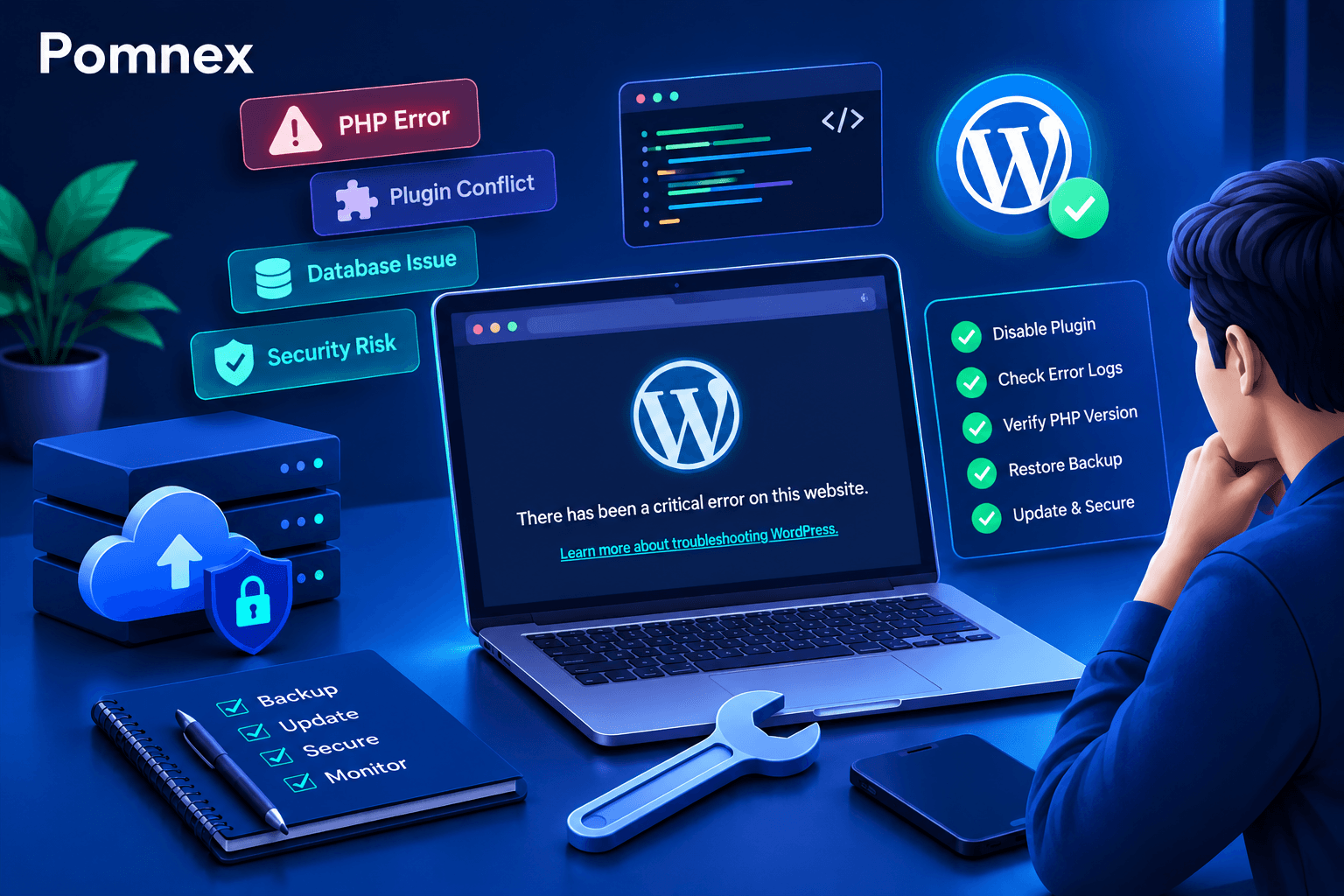
How to Fix the WordPress Critical Error After a Plugin Update
Did a plugin update trigger a critical error on your WordPress site? Learn how to identify the cause, check error logs, disable the faulty plugin, and safely restore your website.
wordpress-maintenance
WordPress Site Health Check: 9 Tests Every Website Owner Can Run
Learn how to check your WordPress site's health with practical tests for performance, security, email delivery, broken links, scheduled tasks, and website functionality.
wordpress-maintenance
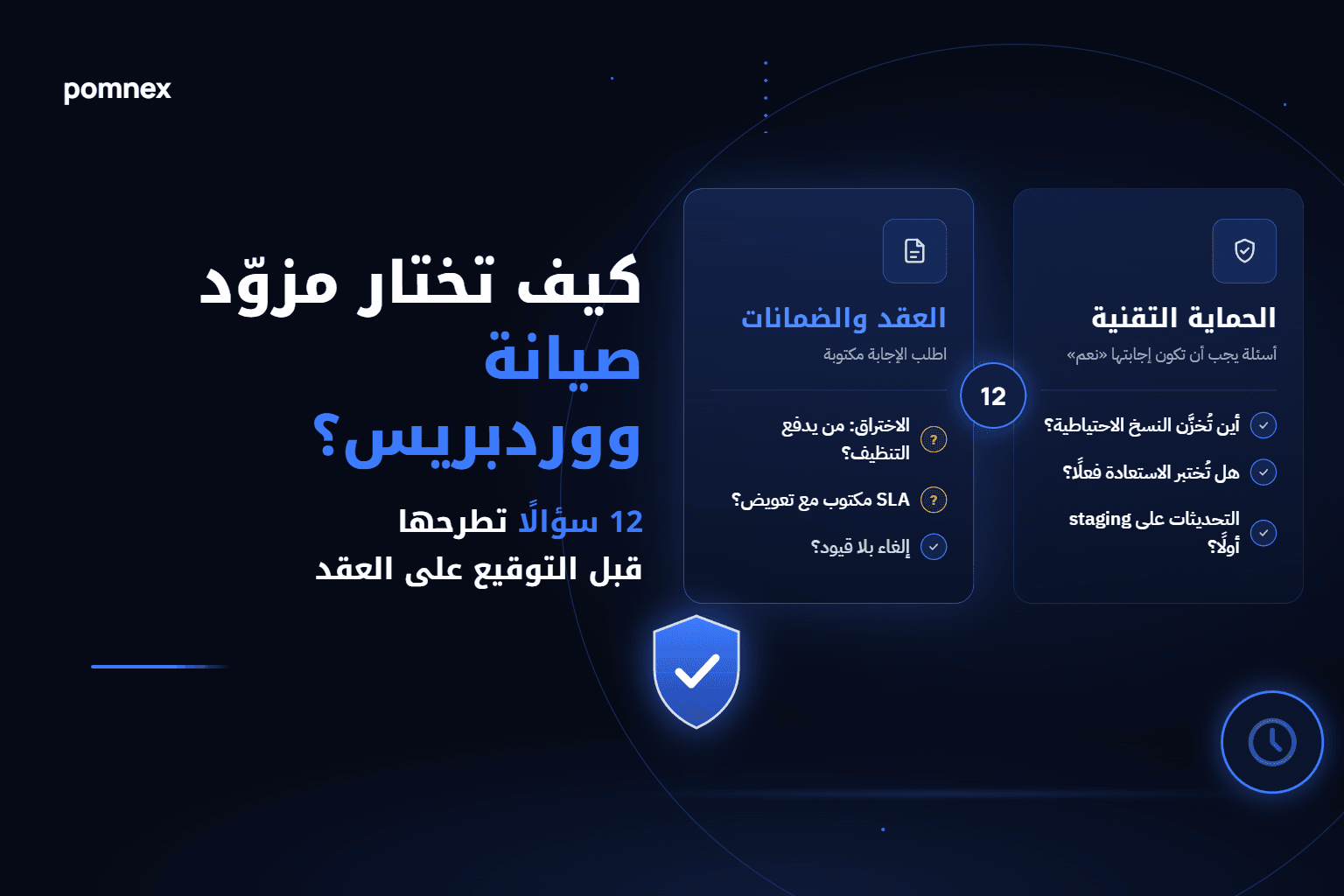
How to Choose a WordPress Maintenance Provider: 12 Questions to Ask Before You Sign
Before you sign with a WordPress maintenance provider, ask: where are backups stored, are restores tested, are updates staged first, who pays when you're hacked? An honest checklist plus a comparison of provider types.